


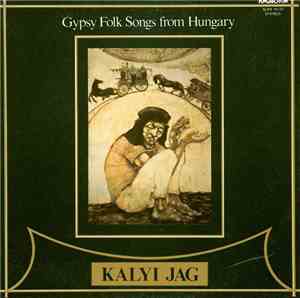
Kalyi Jag - Fekete Tűz / Black Fire - Gypsy Folk Songs From Hungary
- Singer: Kalyi Jag
- Album's title: Fekete Tűz / Black Fire - Gypsy Folk Songs From Hungary
- Genre: Folk, World, & Country
- Label:
Hungaroton – SLPX 18132
Type: Vinyl, LP, Album
Country: Hungary
Date of released: 1987
Category: Folk, World, & Country
Style: Romani - Format: FLAC MP3 AIFF TTA ADX VOC WAV DMF AAC
- Size MP3 ZIP: 1347 mb
- Size FLAC ZIP: 1801 mb
- Rating: 4.3/5
- Votes: 324
Links
- 1347 downloads at 19 mb/s
MP3 version
- 1801 downloads at 22 mb/s
FLAC version
Tracklist Hide Credits
| A1 | Szo Rodesz Tu, Phrála / What Are You Looking For, Brother (Slow Song From Szatmár) | 2:15 |
| A2 | Keren, Savorále, Drom / Make Way, Children (Rolled Song From Szatmár) | 2:30 |
| A3 | Sukar Szasz Amari Bóri / Our Daughter-in-law Was Fair (Slow Rolled Song From Szatmár) | 2:26 |
| A4 | T'al O Del Bahhtalo (May God Be Lucky (Slow Song From Szekszárd) | 2:50 |
| A5 | A) Sudetut, Sej; B) Nyevo Vurdon Keradém / A) Follow Me, Girl; B) I've Had A New Cart Made (Rolled Songs From Szekszárd) | 4:50 |
| A6 | Szájbőgő-Improvizáció / Oral Bass Improvisation | 2:09 |
| A7 | Zsi Tehára Cirdel Banda / The Band Played Till The Morning (Rolled Song From Szabolcs) | 1:49 |
| A8 | Szosztar Manga Kadala Love / What Do I Need That Much Money For (Transdanubian Slow Song) | 1:41 |
| A9 | Rumeláj (Roumanian Gypsy Dance From The Balkans) | 2:36 |
| B1 | Starvarestajdúj Ratya / For Forty-two Nights (Dance Song From Nagyecsed) | 2:10 |
| B2 | Fáni / FannyComposed By – Gusztáv Varga* |
3:24 |
| B3 | Szosztar Mange, Mama / What's My Young Life (Slow Song From Szatmár) | 2:18 |
| B4 | Nyírbátori Pergető / Rolled Song From Nyírbátor | 2:00 |
| B5 | Szode Seja, Szode Na / As Many Girls There Were (Stick Dance Tune From Szatmár) | 2:20 |
| B6 | Zsal E Ráca Po Páji / The Duck Goes In The Water (Rolled Song From Nagyecsed) | 1:38 |
| B7 | Mamo, Mamo / Mother, Mother (Transdanubian Slow Song) | 1:53 |
| B8 | Aj, Lako Gyí / Her Soul Is (Rolled Song From Nyírvasvári) | 3:47 |
| B9 | Mér Te Merel Muri Dej / Why Should My Mother Die (Slow Song From Nyírvasvári) | 1:54 |
| B10 | Van Egy Pipám, Egy Kalapom / I Have A Pipe And A Hat (Rolled Dance Song) | 2:18 |
Credits
- Arranged By – Béla Balogh* (tracks: A6), József Balogh* (tracks: A1, B8), Kalyi Jag Group* (tracks: A2, A3, A5, A7, A9, B3 to B6, B10), Ágnes Künstler* (tracks: A8, B9), Gusztáv Varga* (tracks: A4, B1, B7)
- Engineer [Balance] – János Horváth
- Finger Snaps – Ágnes Künstler* (tracks: A3, A5, A7, B8)
- Guitar – József Balogh* (tracks: A4, A5, B6), Gusztáv Varga* (tracks: A5, A7, B1, B2, B4)
- Mandolin – József Balogh* (tracks: A5, A7, A9, B2, B4)
- Painting [Front Cover, Inside], Design – István Szentandrássy
- Performer [Dance] – Béla Balogh* (tracks: B10), Gusztáv Varga* (tracks: B8, B10)
- Performer [Water Can] – Béla Balogh* (tracks: A3, A5 to A7, A9 to B2, B4 to B6, B8, B10)
- Photography By – Andrea Felvégi
- Producer [Recording] – Gábor Eredics
- Spoons – Gusztáv Varga* (tracks: B6, B8)
- Supervised By [Revised By], Liner Notes – Katalin Kovalcsik
- Tambura – József Balogh* (tracks: A4)
- Translated By – Judit Pokoly
- Vocals [Oral Bass] – Béla Balogh* (tracks: A3, A5 to A7, A9, B2, B4, B5, B8, B10), József Balogh* (tracks: A3), Gusztáv Varga* (tracks: B6)
- Voice – Béla Balogh* (tracks: A2), József Balogh* (tracks: A1, A2, A5, A7, A9, B2 to B5, B8 to B10), Ágnes Künstler* (tracks: A2, A5, A8, A9, B2, B4, B6, B9, B10), Gusztáv Varga* (tracks: A2 to A5, A7, B1 B2, B4, B7 to B10)
- Whistle – József Balogh* (tracks: A2), Gusztáv Varga* (tracks: A2)
Notes
Includes a fold-out insert with Hungarian and English liner notes and lyrics"The first record of the group called Kalyi Jag (’Black Fire’) is an extraordinary venture for several reasons: they play and sing traditional Gypsy folklore, trying at the same time to adapt itt to their individual personalities and their contemporary musical environment. The „Young masters of folk art”, a title the group from Szatmár county (North-East Hungary) merited in 1979, give performances in workers’ hostels, community centres, theatres as well as various European towns.
The music they play is traditional, yet not quite: once folk music has been uprooted from the medium that produced and fosters it, once it is performed as an artistic production rather than used, it automatically alters, adjusting to its new (stage) function and setting. Nearly all the songs on the record are genuine folk songs. The lyrics and tunes original, but their adaptation has been the group’s invention. Apart from a thin layer of instrumental musicians, Hungarian Gypsies do not play any instruments; they render their folk songs exclusively vocally, and it is only to accompany dance songs that they resort to ’instruments’ – some household utensils (watercan, pot-lid, spoons) to produce percussion effects. The group has not parted with this custom: the water-can is there is the accompaniment of nearly every dance tune. But what is the guitar and the mandolin used for then?
In the ’60s young Hungarians began to try their hands at the guitar. They wanted to create a new musical culture for the young free from the hackneyed sugary schlager tunes. Gypsy youth also began to take to the guitar, some playing the same type of music as the young Hungarians, others who lived in traditional communities and regarded folklore as their „musical mothertongue” providing instrumental accompaniment to their indigeneous songs. This rapidly spreading fashion has left almost no Gypsy community in Hungary without young guitarists. It is natural for today’s teenagers to dance and sing to guitar accompaniment. The guitarist must adapt to the songs of the community, but the songs ’adapt themselves’ as well: they get transformed so as to fit the guitar accompaniment. That is how the instruments have made their way into the Kalyi Jag group. Otherwise, their fine voices and talents at vocal improvisation, a characteristic legacy of Gypsies, continue to be a source of great delight to the listener similarly to conventional folk music records. What is new compared to the traditional practice is the structuring of the songs and the addition of instrumental passages to introduce a song and fill the spaces between stanzas.
The main appeal of Gypsy folk music is precisely its opennes to new inlfuences. It is capable of assimilating strong external musical influences, retaining at the same time its distinctive character. Today, external impacts arrive from popular dance music. They enrich the adaptations, leaving the essential components of the musical material intact.
The group seek to enlarge their repertoire in two ways: they learn the music and performance styles of other (non-Szatmár) Gypsy groups, and they mould their songs so as to please the young audience fascinated by popular dance music. That is why the record includes besides ’native’ songs (from Nagyecsed) melodies from the Szabolcs, the Great Plain and West Hungary, as well as the adaptation of an originally Roumanian-language song of Balkanian tone, a tribute by the group to Roumanian-speaking Gypsies. Most songs are rendered in Romani, as it is part of the group’s endeavours to promote their mother tongue. The lyrics are transcribed according to Hungarian ortography with a view to Romani-speaking Gypsies in Hungary.
The members of the group display a wide versatility of talents: they sing stick-dance tunes in asymmetric rhythm (3/8; the exclusive accompaniment to the Gypsy stick dance), polyphonic songs and traditional monophonic slow songs from Szatmár, and lively many-voiced dance songs. The dance songs are performed in their traditional style. The rolled virtuosic leading voice-part studded with onomatopoeic effects in accompanied by oral bassing, a popular term derived from the analogous bass part of the ’restaurant’ Gypsy bands. This colourful repertoire finely blends tunes in traditional performance style, adaptations and songs in a more popular taste like the slow song ’What do I need that much money for?’ (A/8) or a composition by the leader of the group, Gusztáv Varga (’Fanny’, B/2).
It is by no means accidental then that the music the listener finds on this record differs from the three Gypsy folk music records so far released in Hungary. Young Gypsies have also awakened to the need of having modern music which still has a distinctive Gypsy character. One of the first outcomes of these efforts is this record of the Kalyi Jag group."
(Katalin Kovalcsik)
Other versions
| Category | Artist | Title (Format) | Label | Category | Country | Year |
|---|---|---|---|---|---|---|
| HCD 18132 | Kalyi Jag | Gypsy Folk Songs from Hungary (CD, Album) | Hungaroton Classic | HCD 18132 | Hungary | 1994 |
| MK 18132 | Kalyi Jag | Gypsy Folk Songs From Hungary (Cass, Album) | Hungaroton | MK 18132 | Hungary | 1987 |
Recommendations
Related music:
-
Sioux - Songs Of The Sioux -
Various - Gypsy Folk Songs From Hungary -
Georgian Folk Song And Dance Ensemble / Vocal Ensemble "Gordela" - Georgian ... -
Various - Songs Of Rhodes, Chalki And Symi -
Andor Bura Kovács And His Gipsy Band, Vera Jákó, Anna Gergely - Nincs A Pus ... -
The Ironwood Singers - Traditional Songs Of The Sioux (Live At Rosebud Fair ... -

Various - Magyar Dalok